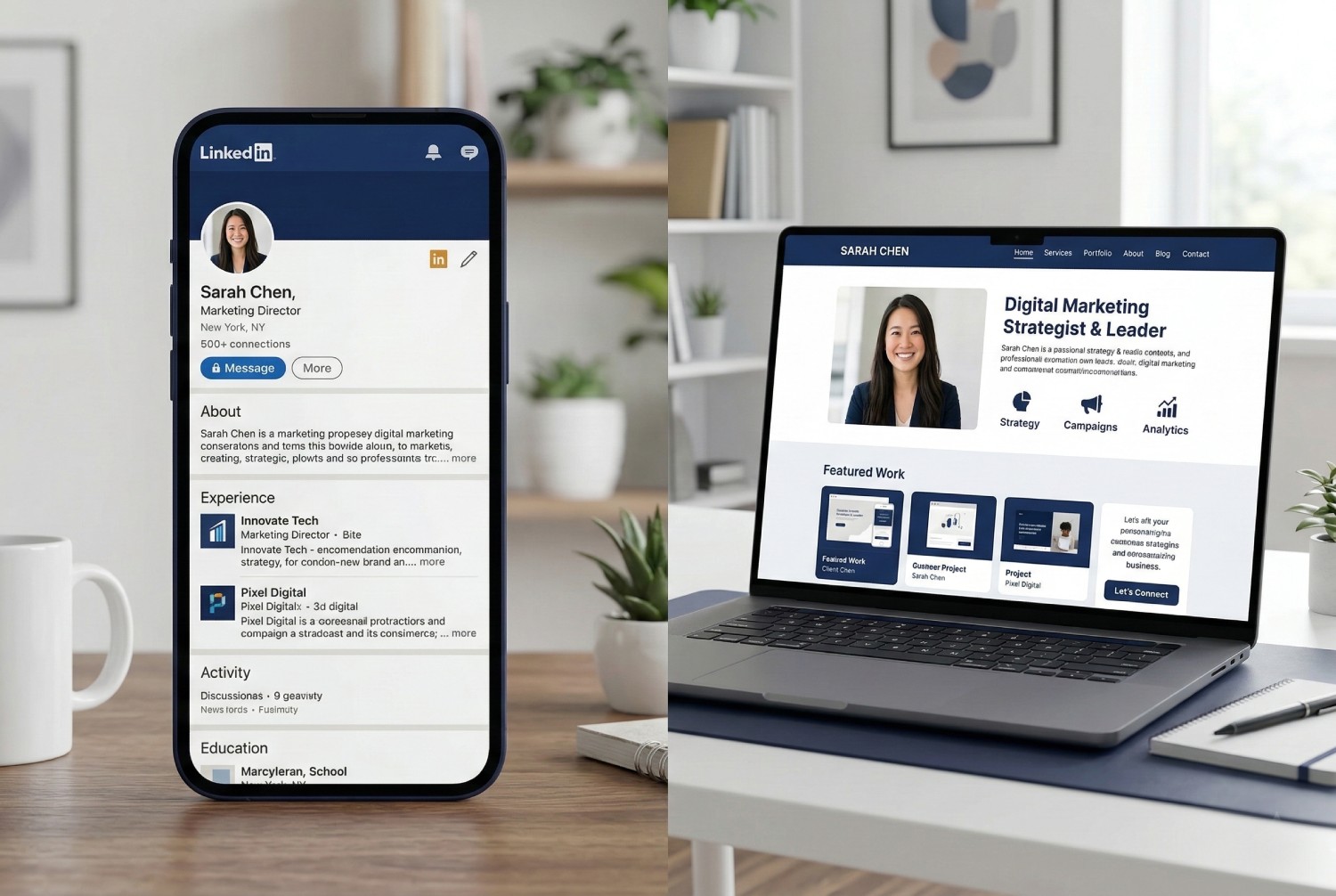
How to Get Clients as a Consultant, Coach, or Fractional Executive: The 2026 Strategy

VisePage Team
March 10, 202611 min read
How to Get Clients as a Consultant, Coach, or Fractional Executive: The 2026 Strategy

Most professional practice websites are expensive brochures. They describe who the practitioner is, list services with vague labels like "executive coaching," "strategic advisory," or "fractional leadership," and close with a Contact Me form that implies a three to five business day wait.

Clients do not book brochures. They book people they trust — professionals who made them feel understood immediately, showed proof they had solved exactly that problem before, and made it effortless to take the next step.

Whether you are a fractional CFO looking for your next engagement, an executive coach building a waitlist, or a strategy consultant trying to move from referrals to inbound, the independent professionals who consistently generate leads from their websites have made different decisions. Not about design or technology. About structure, copy, and the sequence in which they present their case.

Mistake Number One: Leading With Your Story Instead of Your Client's Problem

The most common professional practice website mistake is not bad design. It is the wrong first line.

Visit any coach or consultant's homepage and you will likely find the same opening. "I am a seasoned executive coach with 20 years of experience helping leaders grow." Or: "We are a boutique fractional CFO practice serving high-growth technology companies." Both open by making the practitioner the subject. But the visitor who just landed on that page is thinking about their problem, not about who you are.

Your homepage should open with what your ideal client is experiencing right now. Their frustration. Their bottleneck. The gap between where they are and where they need to be.

Rewrite from: I am an executive coach with 20 years of experience.
Rewrite to: First-time VPs hire me when they know they are capable of operating at the next level — but cannot yet see how to get there.

Or for a fractional CFO: Founders hire me when their financial operations are holding back what the business is capable of becoming.

Both versions pass the so-what test: the visitor immediately understands what problem you solve and whether they have it. Apply this across your entire site. Services pages often read like capability lists. About pages read like CVs. Every section should stay anchored in the client's experience, not yours.

The Four Stages Every Prospective Client Goes Through

Every prospective client — whether evaluating a fractional CFO, a growth coach, or a strategy consultant — moves through the same four stages in sequence. Understanding this makes it easy to see why a website is not converting.

Stage 1: Problem recognition

The visitor arrives with a problem. They are not browsing; they are looking for evidence that you understand their specific situation. If they do not see that within the first few seconds, they leave.

Stage 2: Credibility assessment

Once they believe you understand their problem, they ask: has this person solved this before, for someone like me? A fractional CFO buyer is asking about fundraising outcomes and financial systems transformations. A coaching client is asking about leadership transformations in comparable situations. Generic credibility signals — years of experience and impressive employers — are far weaker than specific proof of outcomes.

Stage 3: Fit evaluation

Assuming credibility holds, they ask: is this person right for our specific situation? This is where your engagement models, your ideal client description, and your current availability become critical. Ambiguity at this stage is the most common cause of interest that never converts to outreach.

Stage 4: Action

A convinced visitor wants to do something. Your job is to make that action frictionless. One clear call to action — a booking link, a discovery call offer, a lead capture form — converts far more effectively than multiple competing options.

Most professional practice websites do stage one passably and fail at stages two through four. They have credentials but no case studies. They describe services but not engagement models or coaching programs. They end with a contact form rather than a calendar link.

The Five Sections Every Serious Professional Practice Website Needs

1. A hero that opens with the client's problem

The homepage headline has one job: make a problem-aware visitor feel immediately understood. It does this by naming the problem or the outcome — not the service category.

Weak: Fractional CFO. 20 Years in Finance.
Strong: Building the financial infrastructure that lets fast-growing companies stop worrying about money and start focusing on what they are building.

Weak: Executive Coach. ICF Certified. 15 Years Experience.
Strong: Senior leaders hire me when they are operating at their ceiling — not because they are failing, but because the skills that got them here will not get them to the next level.

The proof block follows immediately, not after a long introduction. Two or three client outcomes, a prominent metric, or a concise testimonial. This must appear above the scroll line on both desktop and mobile.

2. Services written in outcome language

The services section is where most professional practice websites leave the most revenue on the table.

The standard approach is a bulleted list of service categories: Strategic Planning. Fractional CFO Services. Executive Coaching. Leadership Development. These are categories, not propositions. A prospective client reading this cannot understand what they will actually receive, how long it takes, what it costs, or what they will be able to do differently at the end.

The better approach structures each offering as a short narrative: who it is for, what it produces in the client's language, how it works, and what the investment looks like. A coach with a 12-week leadership program, a fractional CFO offering both retainer and project-based engagements, and a strategy consultant offering 90-day sprints all benefit from the same approach — describe the outcome first, the mechanics second.

3. Case studies: your single most powerful sales asset

Case studies are consistently underinvested on professional practice websites and consistently the highest-return section when added. This is true for coaches, consultants, and fractional executives equally.

Most practitioners avoid them for three reasons: NDAs, time, and perfectionism. All three are solvable.

  • NDAs: anonymise by industry and client stage. "A PE-backed manufacturing company at $40 million revenue" for a consultant, or "a first-time Chief People Officer at a Series B tech company" for a coach, conveys the right context without identifying anyone.

  • Time: the structure below takes around 30 minutes per case study to complete.

  • Perfectionism: a published 80 per cent case study converts clients. An unpublished 100 per cent case study converts no one.

The structure that works: Context (client profile and starting situation), Challenge (what was broken and what the stakes were), Approach (four to six specific actions), Outcomes (two to four quantified results with before-and-after figures and a timeframe).

"Helped a Series B SaaS company extend runway from 4 months to 18 months by restructuring vendor contracts and reducing burn 40%." Three case studies built this way are worth more than ten pages of service descriptions.

4. Testimonials: more than you think you need

Most practitioners publish three testimonials. Three is not enough.

Whether you are a coach, a fractional executive, or a consultant, your services represent a significant investment of money and trust. Prospective clients read extensively before deciding. Three testimonials raises questions. Fifteen builds conviction.

The testimonials that convert are specific about outcomes, not about how pleasant the engagement was. "Reduced our finance close from 18 days to 4 days" is more compelling than "was a pleasure to work with." "Helped me show up as a leader instead of a technician, which directly contributed to my promotion six months ahead of schedule" is more compelling for a coach than "incredibly supportive and easy to work with." Both may be true. Only one moves a prospective client closer to booking.

5. A booking link, not a contact form

The contact page is where most professional practice websites make their final and most expensive mistake: a generic contact form with name, email, and message fields, and no indication of when you will respond or what happens next.

A Calendly link converts interest directly into a scheduled conversation. The prospective client does not wait for a reply. They do not compose a careful email wondering how to position their enquiry. They pick a time that works and show up.

For an executive coach offering a free chemistry call, a fractional CFO offering a confidential strategy session, or a consultant running a scoping conversation — the mechanic is the same. One click from interested to a confirmed meeting on the calendar.

One client booked through a Calendly integration covers the cost of VisePage Pro for multiple years. It is the most underestimated conversion change available on any professional practice website.

The Booking Link Is the Single Highest-Impact Change You Can Make

A contact form creates a gap between interest and conversation. Submit form, wait, receive reply, reply back, suggest times, agree on a date, prepare, meet. The entire process takes days and requires four to six exchanges. In that time interest cools, other priorities take over, and a meaningful percentage of would-be clients never materialise.

A Calendly link collapses that process to one step. Interest converts to a confirmed meeting in 30 seconds. The psychological commitment is entirely different from an email thread.

The language around the booking link matters too. "Contact Me" is passive. "Book a Strategy Call" is active and specific. "Book a Confidential Consultation" adds a layer of trust that substantially increases click-through — particularly effective for fractional CFOs, executive coaches handling sensitive leadership challenges, and any practitioner where trust is the primary purchase barrier.

Add a Calendly link. Put it in your hero section. Make it the primary call to action on every page. If you do nothing else from this article, do this.

Case Studies Outperform Everything Else on Your Site

Most practitioners spend more time on their About page than on their case studies. This is backwards.

A well-written About page builds rapport. A well-written case study closes business.

If you have no published case studies yet, here is how to start:

  1. Pick your three most impactful client engagements from the past three years.

  2. Write a paragraph for each using the Context, Challenge, Approach, Outcome format.

  3. Show each one to the client and ask permission to publish in anonymised form.

  4. In most cases the client agrees — they are often proud of what you achieved together.

  5. If a client declines, publish without any client reference. Use an industry and stage description instead. "A $12 million B2B SaaS company needed to rebuild its pipeline strategy after missing revenue targets for two consecutive quarters. Here is what we did and what it produced."

Three published case studies built this way do more to convert website visitors into clients than any amount of service description writing, About page copy, or design investment.

SEO: The Long-Term Channel Most Independent Professionals Ignore

Every week a coach, consultant, or fractional executive operates without a professional website is a week where prospective clients searching for their specific expertise find someone else instead.

The keywords that matter most are specific combinations of role, specialty, and context. Fractional CFO for SaaS companies. Executive coach for first-time vice presidents. Management consultant for family business succession. Fractional CMO for B2B demand generation. These searches are conducted by clients who know what they need and are actively evaluating options.

Ranking for them is not instant — it typically takes 6 to 18 months of consistently published, quality content. But the leads generated are among the highest-intent you will encounter, and the channel compounds over time with no ongoing spend.

A 30-Day Website Optimisation Sprint

If your website is currently not generating enquiries, here is a four-week plan to change that. No redesign, no new platform — just the changes that move the conversion needle most.

Week 1: Rewrite the homepage opening

Identify the single most common problem your ideal clients have when they come to you. Rewrite your homepage headline and first 100 words to open with that problem in their language. Test with two people who match your ideal client profile and ask if they immediately understand what you do and who it is for.

Week 2: Publish one case study

Choose your strongest recent client outcome. Write it in the Context, Challenge, Approach, Outcome format. Get permission. Publish it. One specific, outcome-rich case study is worth more than a complete redesign.

Week 3: Replace your contact form with a booking link

Add Calendly to your website, replacing or supplementing your contact form. Make it visible without scrolling on desktop. Test the booking flow from a mobile device. Confirm the confirmation and reminder emails are configured correctly.

Week 4: Add a testimonials section

Contact three to five past clients with a simple, direct testimonial request. Ask for two to three sentences: what the situation was when you started working together, what changed, and what the outcome was. Even one published, outcome-specific testimonial measurably increases conversion.

The Compounding Effect

Each of these changes builds on the others. A strong homepage keeps visitors engaged long enough to read your case studies. Case studies create the proof that converts testimonial requests into willing respondents. Testimonials build the conviction that gets the booking. The booking delivers the first conversation that converts to a client.

Your website is not a business card. It is a practice development tool that works 24 hours a day. The question is whether you have given it what it needs to do the job.