Create a Financial Advisor Website That Answers Trust Questions Early
Prospects evaluate advisors carefully. Your site should answer trust questions before the first call. By the time someone clicks book, they should already understand who you help, how you work, and what to expect.
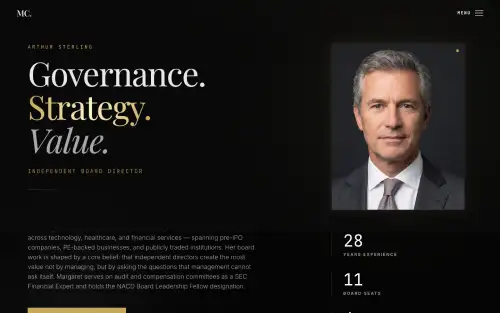
Board Director
Formal governance profile template tailored for board nominations, committee expertise, and credibility-led positioning.

Financial Advisory Trust Barrier
Clients make high-stakes decisions and need evidence of professionalism and process.
Websites without fee and fit clarity lose serious prospects before contact.
Advisory prospects need confidence in your professionalism, process, and communication style before sharing financial details.
A dedicated advisor website creates a transparent and compliant path from first visit to qualified conversation.
LinkedIn vs a Trust-Building Financial Advisor Website
LinkedIn establishes credibility. Your advisor website should answer trust, fit, and process questions that drive booking decisions.
Standard Profile
Status Quo
- Buyer impressionLooks like a profile
- Proof formatBrief wins with limited context
- Offer clarityOften implied or fragmented
- Next stepGeneric contact options
- Search potentialMostly tied to the platform
- What someone can share internallyA quick background check
Professional Platform
Recommended Strategy
- Buyer impression Shows what you help with and why it matters
- Proof format Planning process timeline, meeting cadence, and expectations
- Offer clarity Fee-model clarity and ideal client profile
- Next step Compliance-aware content, transparent disclaimers, and a clear booking path
- Search potential A page written around financial advisor searches
- What someone can share internally A page a referral can pass around before the call
What a Financial Advisor Website Should Clarify Before the First Call
These sections help serious prospects evaluate whether your planning model and client profile align with their needs.
- Credentials, registrations, and fiduciary signals up front
- Fee-model clarity and ideal client profile
- Planning process timeline, meeting cadence, and expectations
- Compliance-aware content, transparent disclaimers, and a clear booking path
Turn Your LinkedIn Profile Into an Advisor Website That Builds Confidence
Start with clear trust content, then iterate copy and disclosures based on the questions prospects raise most often.
Start with your profile
Use your profile as a draft baseline, then center messaging around planning outcomes and fiduciary trust.
Be clear about fit
Define ideal client profile, service scope, and fee framing to reduce ambiguity early.
Add proof people can scan
Add process and proof sections with compliance-aware language reviewed by your team.
Make the next step obvious
Set one primary CTA for qualified introductory conversations and clear intake expectations.
Keep it updated
Refresh credential, process, and proof details regularly to keep your page accurate and trustworthy.
What a Financial Advisor Website Should Answer Before Someone Books
These are the sections prospects look for when they are deciding whether to trust you with real financial decisions.
Credential trust bar
Present credentials, positioning, and trust signals immediately.
Planning process timeline
Show how discovery, planning, and review cycles are handled.
Ideal-fit filter
Filter and attract the right asset profile and planning needs.
Consultation intake flow
Enable low-friction first meetings with qualified prospects.
Who Searches for Financial Advisors When Planning Gets Complex
Address these audiences directly to improve inquiry quality and reduce misaligned leads.
- High-income professionals with rising planning complexity
- Business owners preparing for liquidity events
- Retirees needing distribution and risk planning
- Families seeking long-term fiduciary guidance

How to Position a Financial Advisor Website for Search and Trust
Lead with planning outcomes and service approach, then support with credentials and trust markers.
Explain process and fee model in plain language so prospects can assess fit before reaching out.
Keep messaging aligned across LinkedIn, referral conversations, and your website.
Update proof and disclosures on a regular cadence so your page stays accurate and compliant.
Financial Advisor Website Trust Blueprint
Hero and positioning
Help the right buyer know they are in the right place
Credentials, registrations, and fiduciary signals up front
Proof and trust
Give them enough evidence to keep reading
Planning process timeline, meeting cadence, and expectations
Service scope
Explain what working together actually looks like
Fee-model clarity and ideal client profile
Questions and fit
Answer the doubts people already have
Use FAQs and buying cues that match how financial advisor work gets evaluated
Final CTA
Make the next step easy to say yes to
Compliance-aware content, transparent disclaimers, and a clear booking path
Financial Advisor Website FAQ
Should advisors publish fee model details?
Can I add required compliance language?
Is LinkedIn enough for advisor credibility?
Advisor trust grows when transparency is built into the page.
Publish a financial advisor website that helps qualified prospects move forward with confidence.